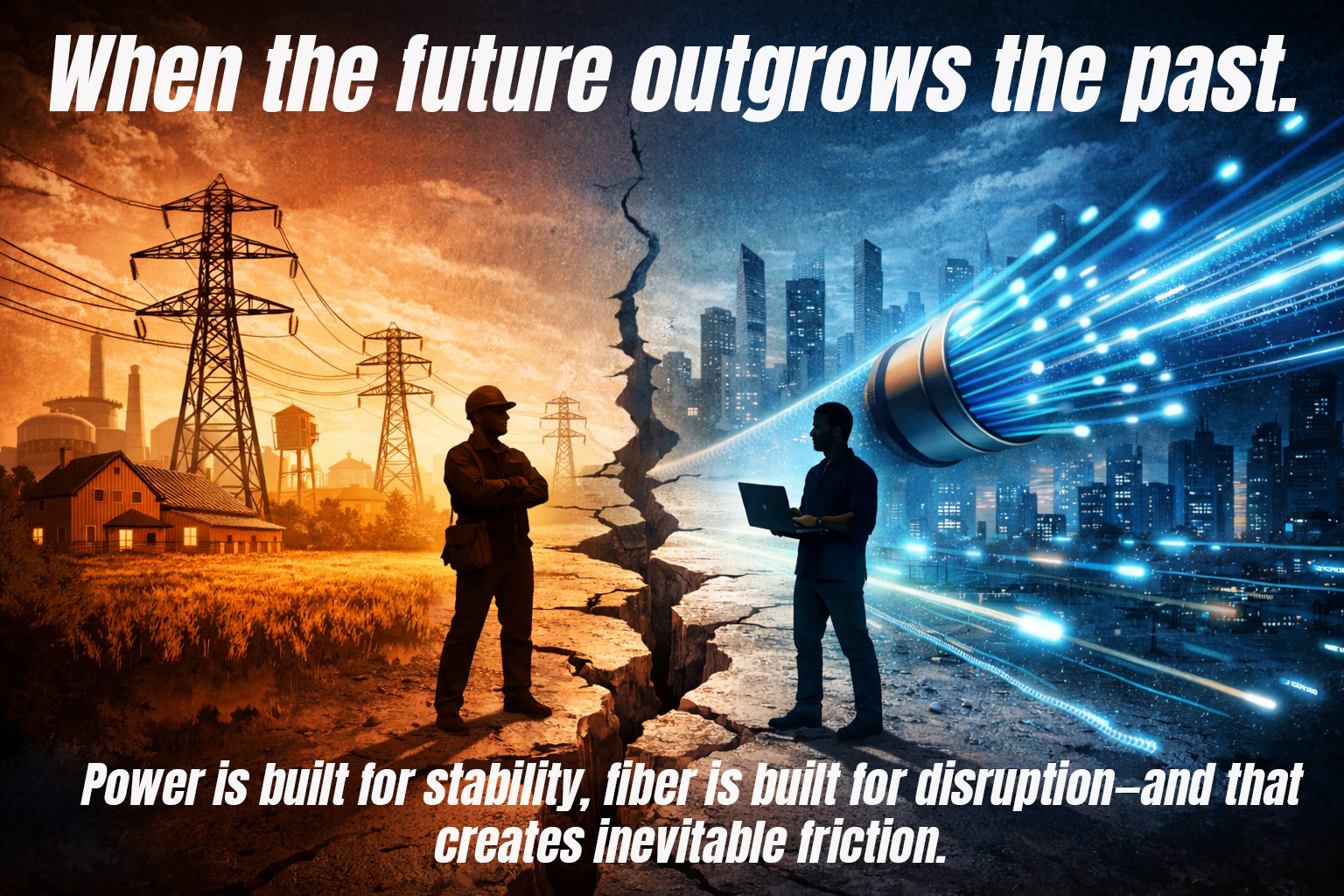
The Inevitable Tension Between Electric Co-Ops and Fiber Broadband Service Providers
Every generation of technology creates the same conflict.
The business that funded the present eventually stands in the way of the business that creates the future.
It’s not driven by ego.
It’s not driven by incompetence.
It’s driven by the simple fact that success creates gravity.
Apple Solved This Problem
In the early 1980s, Apple was already a successful company.
The Apple II was printing money. It dominated the market. It paid for everything else. The team behind it knew, correctly, that they were the reason Apple existed.
Then came the Macintosh.
The Mac team correctly believed they were building the future of computing. The Apple II team believed, also correctly, that the future didn’t pay the bills yet.
Steve Jobs recognized the danger immediately.
If the Mac team were forced to operate under the Apple II team’s rules, culture, and success metrics, it would die before it ever had a chance to succeed.
So he separated them.
Different buildings.
Different leadership.
Different incentives.
One business was allowed to protect and optimize the present.
The other was empowered to challenge it.
Apple survived because it did not ask the present to willingly finance its own replacement.
This Pattern Repeats Because It’s Structural, Not Emotional
Apple isn’t unique.
The same dynamic has played out across industries:
- IBM’s mainframes vs. personal computers
- Microsoft’s desktop software vs. cloud services
- Netflix’s DVD business vs. streaming
- Amazon’s retail business vs. AWS
In each case, the legacy business wasn’t failing—it had finished growing.
And that distinction matters.
Optimization, reliability, and cost control replace experimentation and risk-taking. The organization becomes very good at maintaining what already exists.
And that’s where many electric cooperatives find themselves today.
The Electric Co-Op Reality: Essential, Stable, and Saturated
Electric co-ops solved one of the hardest infrastructure problems in modern history: bringing reliable power to rural America.
They succeeded.
Most co-ops today
- Serve a mature and largely saturated membership base
- Face enormous capital costs to expand physical infrastructure
- Operate in heavily regulated environments
- Optimize for reliability, not rapid growth
Their mission is service, stewardship, and stability—not market expansion. This is not a weakness. It is the natural endpoint of success.
But it does mean the growth narrative has shifted.
Fiber Is Where Growth Lives Now
Broadband, especially fiber, is different in kind, not just degree.
Fiber
- Benefits from substantial state and federal funding
- Addresses a still-expanding demand curve
- Often has less than 50% penetration within existing co-op member bases
- Competes in markets that reward innovation, speed, and differentiation
Most importantly, broadband operates under technology economics, not utility economics.
Moore’s Law applies.
Costs decline. Capabilities expand. Expectations rise. And competitors don’t wait for governance cycles.
Innovation in broadband isn’t optional. Failing to evolve doesn’t lead to stagnation—it leads to irrelevance.
Where the Tension Becomes Unavoidable
The tension doesn’t start with strategy documents or org charts.
It starts quietly when broadband
- Grows faster than the electric business
- Requires new pricing models
- Demands frequent product innovation
- Attracts more attention, capital, and talent
At that moment, the center of gravity shifts.
The electric co-op, long the organizational anchor, no longer feels like the engine of the future, and human nature kicks in.
Oversight increases. Alignment conversations begin. Pressure mounts to “integrate,” “simplify,” or “bring things back together.”
This is where well-meaning governance becomes a growth constraint.
Why Merging the Businesses Is Usually the Wrong Answer
Electric power and broadband are not two sides of the same coin. They are two different businesses with fundamentally different operating logics.
Electric co-ops prioritize
- Reliability over experimentation
- Cost recovery over margin expansion
- Stability over speed
Broadband service providers must prioritize
- Customer acquisition and retention
- Product differentiation
- Continuous innovation
- Competitive pricing and bundling
When these logics are forced into a single operating model, both suffer.
Most failed integrations don’t fail because of bad strategy. They fail because culture cannot be harmonized on command—and culture, not capital or technology, is the hardest thing to unwind once it’s broken.
The Co-Op Advantage Most Broadband Competitors Can’t Touch
Ironically, electric co-ops already possess the most powerful differentiator in broadband: Trust.
Co-ops are
- Community-owned
- Mission-driven
- Locally accountable
- Designed to reinvest, not extract
While private-equity-backed providers extract value and export it, co-ops circulate value locally.
But this advantage only works if broadband is allowed to operate like a real technology business—one that borrows the values of the co-op, not its operating constraints.
How Boards Can Let Both Businesses Win
The tension cannot be eliminated. But it can be governed.
Here are five principles that consistently work.
1. Keep the Brands Separate—but Clearly Related
Broadband must signal innovation and technical credibility, while the co-op signals trust and reliability. They should look like they belong together—but not like the same thing.
2. Protect Independent Operating Models
Broadband pricing, offers, and product roadmaps cannot be governed like power rates. Different economics require different reflexes.
3. Normalize the Shift in Growth Leadership
At some point, broadband will outgrow power. Boards must acknowledge this explicitly—before insecurity drives control behavior.
4. Transfer Values, Not Processes
Community focus, local service, and stewardship should inform broadband. Risk aversion and regulatory thinking should not.
5. Design Governance Intentionally
Undefined relationships create more friction than clear boundaries. Boards should define how these businesses interact before success forces the issue.
A Board-Level Call to Action
This is not an operational problem. It is a governance decision.
Boards overseeing electric co-ops with broadband ambitions must answer three questions—now, not later
- Are we willing to let the future operate differently from the past?
- Do our governance structures enable broadband to compete—or quietly constrain it?
- Have we explicitly designed the relationship between these businesses, or are we hoping culture will figure it out?
The greatest risk is not tension. The greatest risk is pretending that tension can be eliminated without consequence.
The organizations that endure are not the ones that preserve the status quo the longest—but the ones that allow the future to grow without apology.
The center of gravity will move.
The only real choice is whether leadership moves with it—or tries to pull it back.