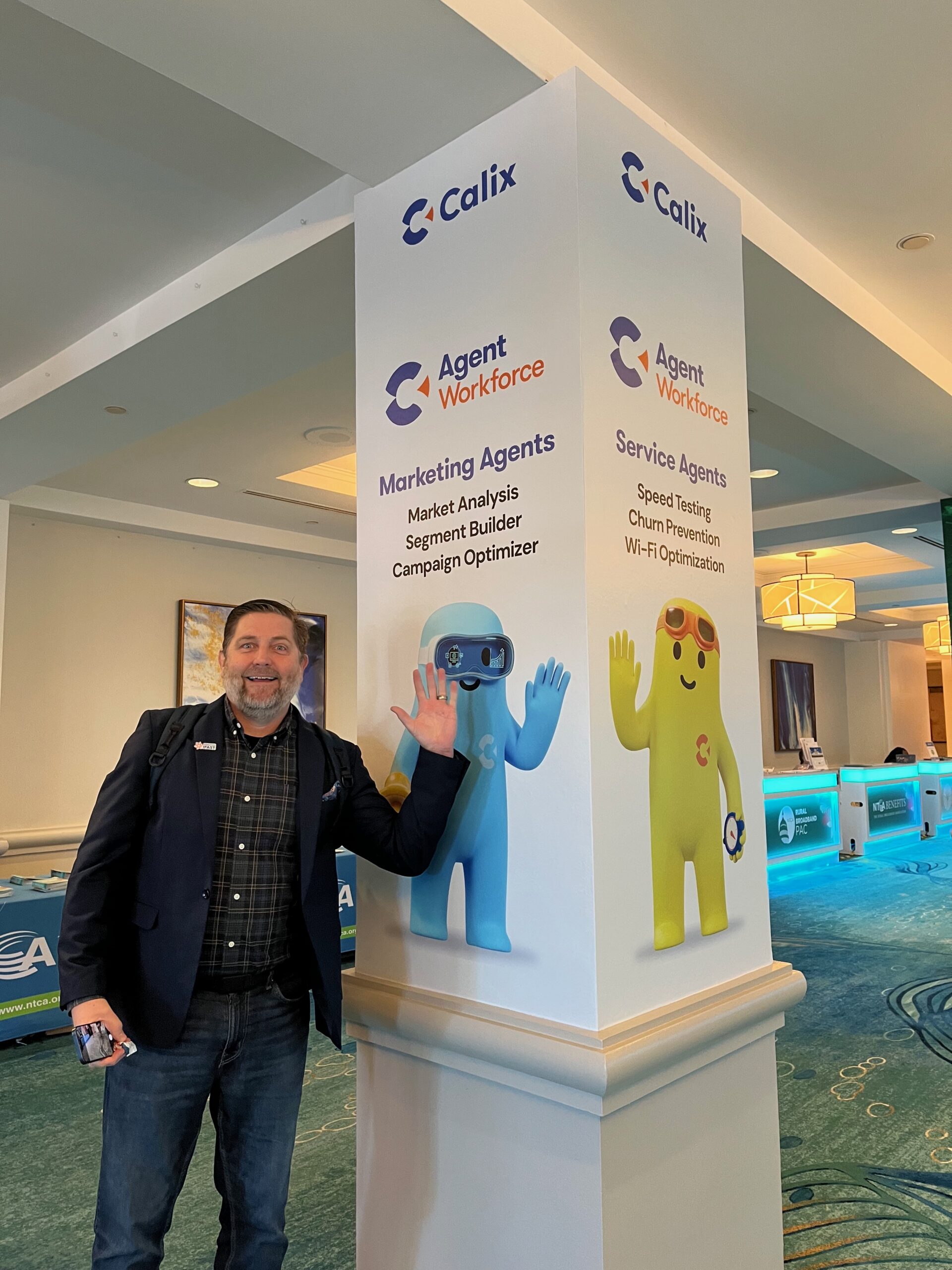
RTIME 2026 (February 22–25) in Orlando felt like a line in the sand for rural broadband. Not because the mission changed—they’re still building and operating networks for communities the market has historically ignored—but because the operating assumptions are changing faster than most org charts.
RTIME 2026 put the big themes on the agenda: sustainable funding, sustainability after the build, and AI moving from “innovation theater” into day‑to‑day operations.
The post-build era is here, and it comes with uncomfortable math
One session title captured the mood perfectly: Rural Broadband Network Expansion and What Comes Next. The description is blunt: as providers complete major phases of network buildouts, the focus shifts to scaling challenges, new technologies and funding streams, and—most importantly—planning for sustainability and long-term maintenance.
Moderated by Brian Ford (NTCA,)the panel brought together operators who are living that transition in real time, Mitchell Bailey (GRM Networks), Chad Bullock (Paul Bunyan Communications), and Chris Townson (West Carolina Rural Telephone Cooperative. And if there’s one message that landed for me, it’s this:
Treat Universal Service Fund support like a strategic variable, not a guarantee.
Yes, the Supreme Court upheld the USF contribution system in 2025, which matters, because the alternative would have been disruptive across rural, low-income, libraries, schools, and health care connectivity. But the structural pressure remains: the contribution factor is recalculated every quarter, and lately those percentages have been extraordinarily high: USAC lists 37.6% for January–March 2026 and 38.1% for October–December 2025.
When the contribution factor becomes that visible—and that politically sensitive—pressure to reform “who pays” and “how much” increases.
NTCA has published contribution reform priorities referencing bills that would direct the FCC to expand the contribution base, and lawmakers have separately proposed reforms that would bring “edge providers” into the base under certain conditions.
Meanwhile, “USF” in rural broadband isn’t a single check. Much of the build reality runs through long-duration, model-based programs like A‑CAM and Enhanced A‑CAM, with deployment obligations, reporting, and performance testing that stretch years beyond initial construction.
BEAD accelerates the build. Sustainability is Not Covered
The Broadband Equity, Access, and Deployment Program (BEAD) is enormous and ambitious. With a budget of $42.45B, it’s designed to connect every American by funding infrastructure partnerships. But programs evolve. NTIA issued a BEAD restructuring policy notice in 2025, a reminder that rules and expectations can change while projects are still ramping.
That’s why my biggest “network expansion” takeaway is operational, not political:
Run your downside analysis now—before the next build phase locks in cost structure.
In my notes from the session, I wrote down variations of the same idea multiple ways: model scenarios, diversify revenue, pursue partnerships, and make sure the business “stands on its own.” (These are my notes from the room—please treat them as paraphrases unless you have a recording.)
“If you look forward 10 years, what do you need to do?” — Session prompt (captured in my notes)
“Proforma model to run scenarios … so you can see what will happen.” — attributed in my notes to Chris Townson (paraphrase)
“Whatever you do next, it has to stand on its own. Not subsidized.” — attributed in my notes to Chad Bullock (paraphrase)
That is the right leadership posture for rural operators who serve extremely low-density markets, where cost-per-location is structurally high and sustainability is a governance-level issue, not just a finance issue.
Agents are arriving, and the biggest risk is “AI orphans”
The second big theme I walked away with:
AI is quickly becoming the lever that lets rural BSPs do more with the team they already have—and without burning them out.
RTIME didn’t treat AI as a side quest. The agenda included Leveraging AI Across Rural Broadband Operations with Gregory Al Aymar (Vantage Point Solutions) and Teresa McGaughey (Calix), explicitly framing AI adoption around governance, enablement, and change management—how you build momentum toward scalable AI, not just experiments.
That framing is why the “AI ORPHAN” problem feels real: if AI lives in one department, with one tool, and no shared context, it dies when the champion gets busy. The fix is to invest in an AI ecosystem that serves multiple lines of business and can reuse the same connective tissue across departments.
This is where agents—and standards like Model Context Protocol (MCP)—enter the story.
Anthropic introduced MCP as an open standard for connecting AI assistants to the systems where data lives, and MCP is widely described (including by Microsoft coverage) as a kind of “USB‑C port for AI applications”—a standard way for AI apps to connect to tools and data. The Linux Foundation’s AAIF announcement also shows the industry is converging on shared agent standards, with MCP listed among the foundation’s inaugural project contributions.
Put simply: agents get useful when they can actually do things, safely, across your stack (ticketing, CRM, billing, provisioning, outage comms, Wi‑Fi telemetry, scheduling). MCP-like approaches reduce one-off integrations and make “one agent” reusable across departments.
And there’s a grounded reason to believe this works: in large-scale customer support deployments, generative AI assistance has been shown to increase productivity and improve interaction quality signals, with especially strong benefits for less experienced agents.
My operator take: automate drudgery, protect the human layer
My favorite “AI moment” at RTIME wasn’t a demo—it was the consistency of the message: AI should not replace your people.It should remove the repetitive work that keeps your best people from doing their best work.
That’s aligned with how RTIME sessions frame AI adoption (governance + enablement) and with the evidence on how AI support tools help frontline agents.
In my notes, I captured a sentiment I’ve heard repeatedly from operators:
- Use AI, but be mindful.
- Pick the use case.
- Don’t make it creepy.
- Don’t let it run wild.
That’s a healthy instinct—especially as MCP and agent ecosystems expand, and security has to be designed in from day one.
Where Subscriber Fits In
One reason I’m bullish on an agent-first operating model for rural providers is that it aligns with the “what comes next” reality. You need to scale operations and expand networks in parallel, under tighter scrutiny, with fewer margin-for-error moments.
At Subscriber, we’re focused on helping broadband providers operationalize AI so it augments teams (not replaces them) and so it can move across departments without becoming an “AI orphan.”
A key concept we’re building toward is a Subscriber Identity Graph—the idea that your household, service, device, network experience, and support history should resolve into a unified operational context. This operational context not only helps deliver a better subscriber experience but also helps you acquire more subscribers, increase ARUP, and decrease churn. We’ll share more on that soon.
If you take nothing else from RTIME 2026, take this:
- Run your “USF-downside” analysis now.
- Use agents to automate drudgery and raise the floor on customer experience—then let your people handle the “moments that matter” where people are actually required.
© 2025 SubscriberGTM.